
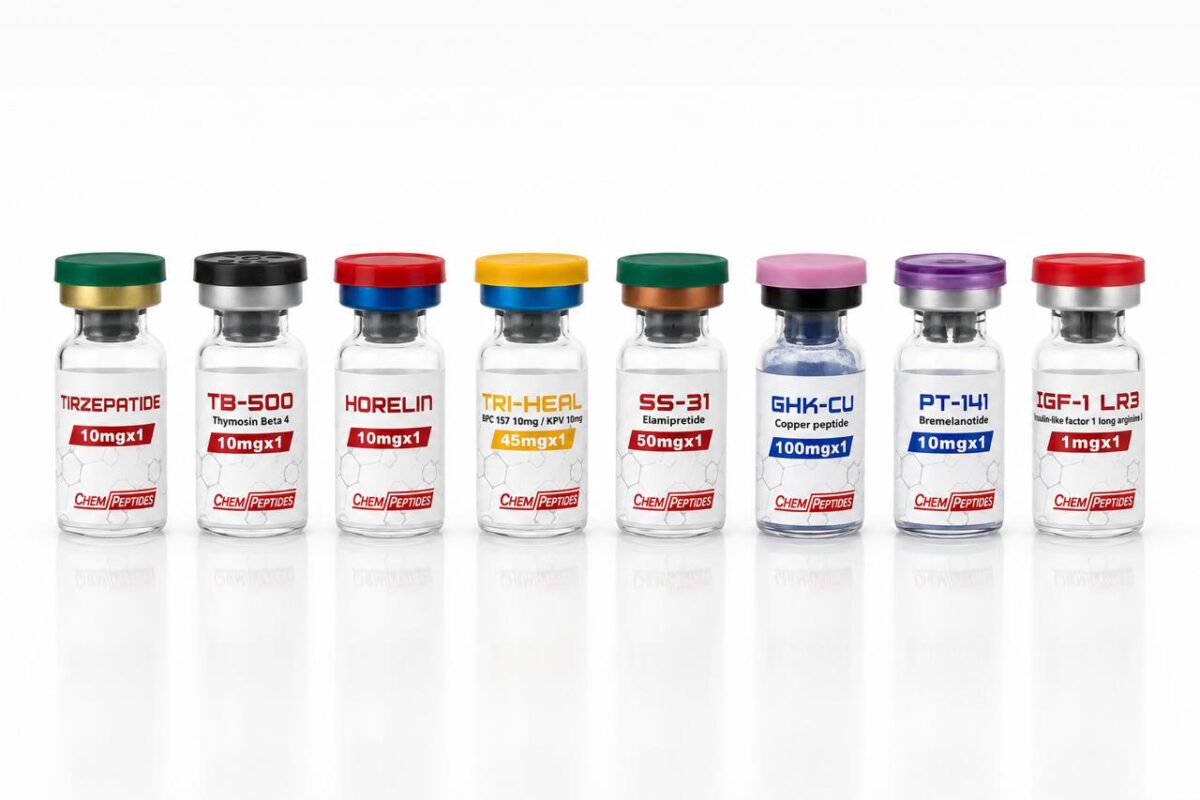
Hexarelin is een synthetisch hexapeptide en groeihormoon-secretagoog dat in de jaren negentig voor het eerst werd beschreven door Deghenghi en collega’s. Het behoort tot de GHRP-klasse, de groeihormoon vrijmakende peptiden, naast GHRP-2, GHRP-6 en ipamorelin, maar met een eigen selectiviteitsprofiel dat unieke cardiovasculaire onderzoekssignalen heeft opgeleverd. Dit artikel brengt dat onderzoek in kaart.
Structuur en sequentie
Hexarelin: His-D-2-methyl-Trp-Ala-Trp-D-Phe-Lys-NH₂. De vervangingen door D-aminozuren en de methylering geven weerstand tegen proteasen. Het hexapeptide is naar molecuulgewicht een van de krachtigste verbindingen binnen de GHRP-klasse.
Receptorprofiel: GHS-R1a en verder
Hexarelin is een krachtige agonist op de groeihormoon-secretagoogreceptor 1a, kortweg GHS-R1a, dezelfde receptor die door ghreline en de overige GHRP’s wordt geactiveerd. Wat hexarelin onderscheidt is aanvullende binding aan de CD36-receptor in hartweefsel, die verantwoordelijk lijkt voor de cardiovasculaire onderzoekssignalen.
Hexarelin tegenover andere GHRP’s
| Verbinding | GH-potentie | Cortisol | Prolactine | Binding cardiaal CD36 |
|---|---|---|---|---|
| Hexarelin | Zeer hoog | Lichte stijging | Lichte stijging | Ja |
| GHRP-2 | Hoog | Duidelijke stijging | Lichte stijging | Lager |
| GHRP-6 | Matig | Stijging plus eetlust | Lichte stijging | Lager |
| Ipamorelin | Selectief | Verwaarloosbaar | Verwaarloosbaar | Nee |
Onderzoek naar de groeihormoonpuls
Hexarelin geeft een sterke, snel oplopende GH-puls die in onderzoeksmodellen 15 tot 30 minuten na subcutane toediening piekt. De amplitude van de puls is vergelijkbaar met of groter dan die van GHRP-2 bij gelijke dosering. De duur is matig, met 2 tot 3 uur tot terugkeer naar het uitgangsniveau.
In combinatie met een GHRH-analoog zoals sermorelin of CJC-1295 geeft hexarelin een synergetische GH-afgifte. De twee routes, de GHRH-receptor en GHS-R1a, staan los van elkaar, en gecombineerde activatie versterkt de omvang van de puls.
Cardiovasculaire onderzoekssignalen
Het meest onderscheidende aan het onderzoeksdossier van hexarelin is cardiovasculaire activiteit die losstaat van de GH-stimulatie. Dieronderzoek rapporteert:
- Hartbeschermende effecten in modellen van myocardischemie (Locatelli en collega’s, 1999)
- Verbeterde samentrekkingskracht van het hart na ischemische schade
- Minder celdood van hartspiercellen door apoptose
- Mogelijke bloedvatvormende effecten in hartweefsel
Deze effecten lijken tot stand te komen via CD36-binding en niet via GHS-R1a, en zijn waarneembaar in muizen zonder GHS-R1a, wat aantoont dat ze losstaan van groeihormoon.
Effecten op cortisol en prolactine
Hexarelin geeft naast de GH-afgifte een lichte stijging van cortisol en prolactine. De omvang daarvan is kleiner dan bij GHRP-2 of GHRP-6 maar groter dan bij ipamorelin. Voor onderzoeksmodellen waarin GH-specifieke effecten moeten worden geisoleerd, verdient ipamorelin de voorkeur.
De plaats van hexarelin binnen de GHRP-klasse
- Onderzoek naar een maximale GH-puls: hexarelin of GHRP-2
- Selectieve GH-afgifte zonder cortisol: ipamorelin
- Studies naar cardiovasculaire bescherming: hexarelin, via het CD36-mechanisme
- Onderzoek gericht op eetlust: GHRP-6, met het sterkste eetlustsignaal
Ongevoeligheid van de receptor
Net als alle GHRP’s kan hexarelin bij chronische of hoogfrequente toediening ongevoeligheid van de receptor veroorzaken. De GHS-R1a receptor wordt neergereguleerd en de omvang van de puls neemt in de loop van de tijd af. Onderzoeksprotocollen bouwen daarom rustperiodes in om de pulsrespons te behouden.
Farmacokinetisch profiel
- Subcutane biologische beschikbaarheid: ongeveer 70 procent
- Halfwaardetijd in plasma: ongeveer 70 minuten
- Piek in de GH-respons: 15 tot 30 minuten na toediening
- Klaring voornamelijk via de nieren
Stabiliteit en reconstitutie
Hexarelin wordt gelyofiliseerd geleverd. Reconstitutie in bacteriostatisch water op 1 tot 2 mg/mL is gangbaar. Het gemethyleerde tryptofaan geeft weerstand tegen oxidatie. Gekoeld bewaarde gereconstitueerde hexarelin behoudt ongeveer vier weken zijn werkzaamheid. Bescherm tegen licht om het tryptofaan intact te houden.
Onderzoekstoepassingen
- Farmacologie van GHS-R1a
- Studies naar cardiovasculaire bescherming via het CD36-mechanisme
- Onderzoek naar de GH- en IGF-1-as
- Synergiestudies met GHRH en GHRP gecombineerd
- Kinetiek van receptorongevoeligheid
Chempeptides levert HPLC-geverifieerde hexarelin met een batchcertificaat. Bekijk de catalogus en ons artikel over ipamorelin voor een vergelijking met de selectieve GHRP.
Uitsluitend voor onderzoeksdoeleinden.
Gerelateerd onderzoek
- Ipamorelin selectieve GH releaser: voordelen tegenover GHRP-2 en GHRP-6
- GHRP-6 voor appetite en bulking research: complete gids met CJC-1295 combinatie
- Ipamorelin onderzoek: de mechanica van de selectieve GH-puls
- Tesamorelin: GHRH-analoog in onderzoek naar lipodystrofie
- Tesamorelin FDA goedgekeurde GHRH analoog: visceraal vet onderzoek
Research disclaimer▾
Alle informatie op deze pagina is bedoeld voor laboratoriumonderzoek en in-vitro studies. Geen humane consumptie. Geen medische claims. Producten zijn niet goedgekeurd door EMA of FDA voor therapeutisch gebruik.
Onderzoeksmateriaal bij dit onderwerp
De peptiden die in spier- en groeihormoononderzoek het meest worden gebruikt:
Betalen met iDEAL of Wero. Verzending in discrete verpakking vanuit Nederland. Uitsluitend voor laboratorium- en onderzoeksdoeleinden.