
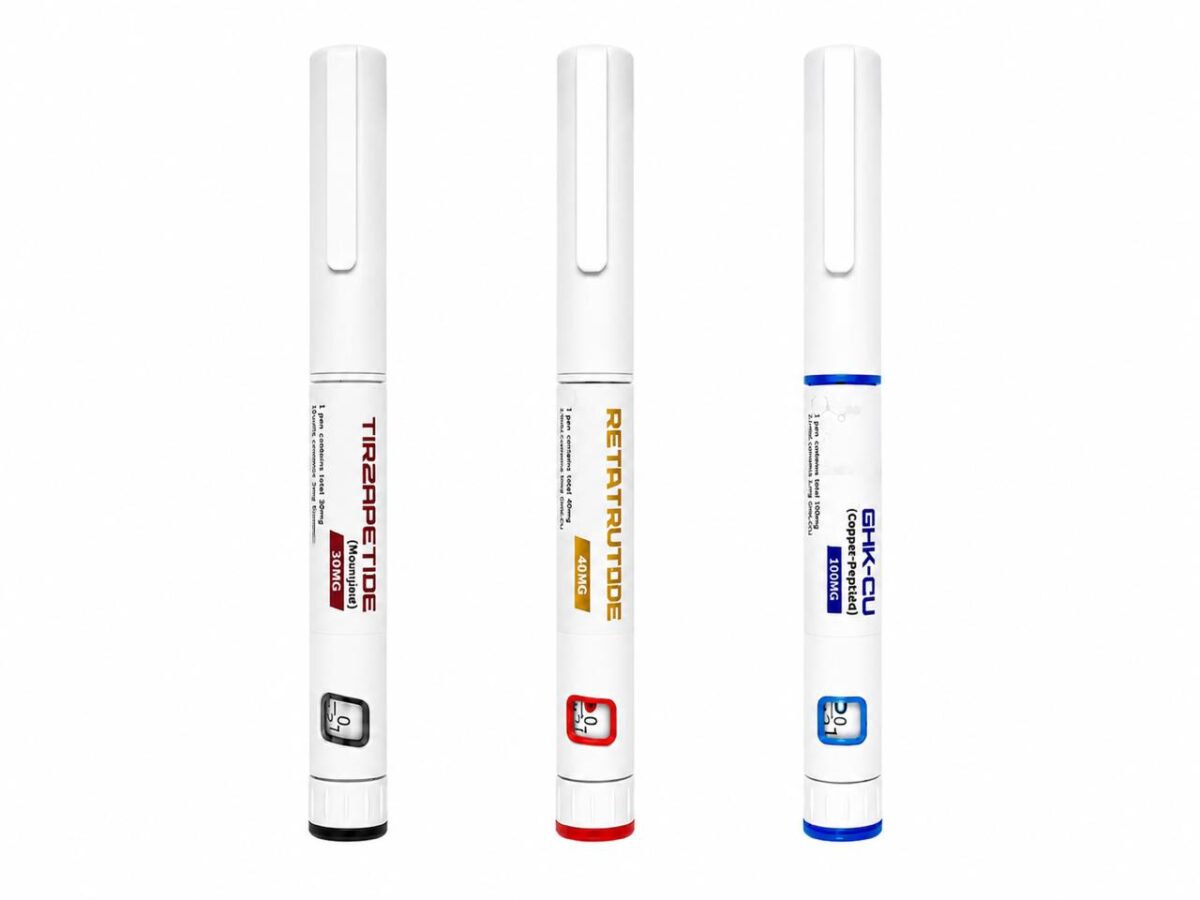
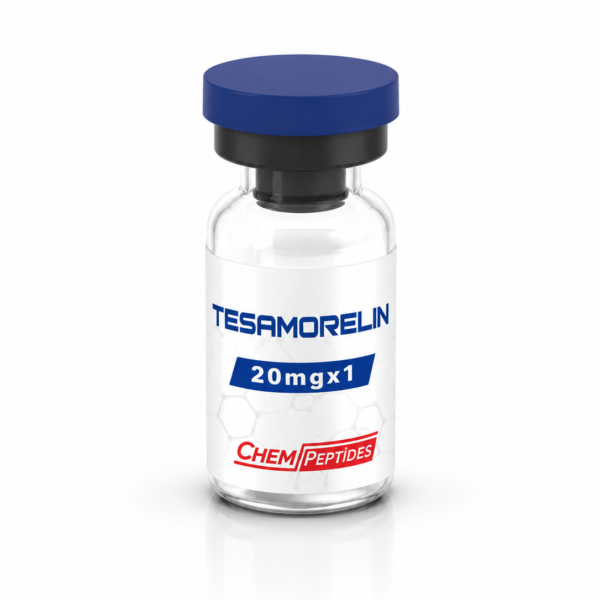
Tesamorelin is een synthetische analoog van growth hormone releasing hormone (GHRH) ontwikkeld door Theratechnologies en in 2010 goedgekeurd voor HIV-geassocieerde lipodystrofie. Het is een van de weinige GHRH analogen die de regelgevende eindstreep haalde, en het onderzoeksdossier is informatief voor de bredere klasse. Dit artikel brengt het mechanisme en de gepubliceerde data in kaart.
Structuur en modificatie
Tesamorelin is GHRH(1-44) met een enkele N-terminale modificatie: een trans-3-hexeenzuur gekoppeld aan de alfa-aminogroep van het N-terminale tyrosine. Deze modificatie verleent resistentie tegen afbraak door dipeptidylpeptidase IV (DPP-IV), waardoor de in-vivo halfwaardetijd wordt verlengd van minuten tot ongeveer 25-35 minuten.
Mechanisme: pulsatiele GH-stimulatie
Net als natief GHRH bindt tesamorelin aan de GHRH-receptor op hypofysaire somatotropen en zet het de afgifte van groeihormoon in gang. De DPP-IV-resistentie betekent dat de prikkel lang genoeg aanhoudt om een betekenisvolle puls aan te drijven zonder onmiddellijk te worden afgebroken. Cruciaal is dat de puls afhankelijk is van resterende somatotroopfunctie: tesamorelin heeft een functionele hypofyse nodig om te werken.
Waarom pulsatiele GH belangrijk is
Endogene GH-afgifte is van nature pulsatiel. Aanhoudende GH-verhoging (zoals bij toediening van exogeen recombinant GH) heeft andere metabole effecten dan het pulsatiele patroon van natuurlijke afgifte. Tesamorelin behoudt de pulsatiliteit: de hypofyse geeft GH af in stoten die passen bij het regulatoire patroon van het lichaam in plaats van het te overschrijven.
Trialdata: reductie van visceraal vet
De cruciale trials (Falutz et al., NEJM 2007, AIDS 2008) onderzochten tesamorelin bij HIV-positieve volwassenen met overmatig visceraal vetweefsel (VAT). Resultaten:
| Eindpunt | Tesamorelin (26 weken) | Placebo |
|---|---|---|
| VAT-reductie (CT-scan) | ~18% | +2% |
| IGF-1 niveaus | Hersteld tot bovenste normaalwaarde | Ongewijzigd |
| Lipidenprofiel | Verbeterde triglyceriden | Ongewijzigd |
De reductie van visceraal vet was preferentieel: subcutaan vet bleef grotendeels behouden terwijl abdominaal visceraal vet afnam. Dit is mechanistisch consistent met het bekende lipolytische effect van GH op visceraal vet.
Hoe tesamorelin verschilt van sermorelin en CJC-1295
| Verbinding | Sequentie | Halfwaardetijd | Klinisch dossier |
|---|---|---|---|
| Sermorelin | GHRH(1-29) | ~10 min | Ouder, minder stabiel |
| CJC-1295 (zonder DAC) | GHRH(1-29) met 4 substituties | ~30 min | Research-grade |
| CJC-1295 (met DAC) | + albumine linker | ~8 dagen | Research-grade |
| Tesamorelin | GHRH(1-44) + N-terminale mod | ~30 min | FDA-goedgekeurd |
Zie ons sermorelin vs CJC-1295 artikel voor de vergelijking van de analogen.
Bijwerkingenprofiel
- Reacties op de injectieplaats (meest voorkomend)
- Gewrichtspijn en stijfheid (gerelateerd aan GH-gemedieerde vochtretentie)
- Milde hyperglykemie bij sommige proefpersonen
- Zeldzame allergische reacties
Waarom specifiek visceraal vet
Visceraal vetweefsel is metabool onderscheiden van subcutaan vet. Het heeft een hogere lipolytische activiteit, brengt andere adipokines tot expressie en reageert sterker op GH. De IGF-1-as mobiliseert bij voorkeur VAT onder verhoogde tonus. Dit is de reden dat een GHRH analoog een preferentiële VAT-reductie teweegbrengt.
Onderzoekshantering
Tesamorelin wordt gelyofiliseerd geleverd. Reconstitutie in bacteriostatisch water op 1-2 mg/mL is standaard. Gekoeld gereconstitueerd tesamorelin behoudt zijn potentie gedurende ongeveer 4 weken. Vermijd vries-dooicycli.
Chempeptides levert HPLC-geverifieerd tesamorelin met batch CoA: zie de catalogus.
Uitsluitend voor onderzoeksdoeleinden.
Gerelateerd onderzoek
- Tesamorelin FDA goedgekeurde GHRH analoog: visceraal vet onderzoek
- Sermorelin vs CJC-1295: Stabiliteitsprofielen GHRH Analogen
- CJC-1295 met en zonder DAC: complete gids voor GHRH analoog onderzoek
- GHRP-6 voor appetite en bulking research: complete gids met CJC-1295 combinatie
- CJC-1295 DAC vs Non-DAC: Stabiliteit en Halfwaardetijd Onderzoek
Research disclaimer▾
Alle informatie op deze pagina is bedoeld voor laboratoriumonderzoek en in-vitro studies. Geen humane consumptie. Geen medische claims. Producten zijn niet goedgekeurd door EMA of FDA voor therapeutisch gebruik.
Onderzoeksmateriaal bij dit onderwerp
De peptiden die in spier- en groeihormoononderzoek het meest worden gebruikt:
Betalen met iDEAL of Wero. Verzending in discrete verpakking vanuit Nederland. Uitsluitend voor laboratorium- en onderzoeksdoeleinden.